
Every pressure injury guideline says the same thing: turn the patient regularly. The 2025 International Pressure Injury Guideline reinforces that no support surface can substitute for repositioning. And yet, manual turning schedules are among the most frequently missed nursing tasks in both acute and long-term care.
Nobody’s arguing the science. The problem is resources.
The Compliance Problem
Turning a patient every two hours sounds manageable on paper. Now picture a single ward nurse responsible for twelve patients overnight, each with different acuity levels, medication rounds, and limited ability to move independently. Published compliance rates for manual repositioning drop to 30 to 50 percent on night shifts. That’s not a staffing anomaly. That’s the norm.
And the consequences aren’t abstract. Hospital-acquired pressure injuries extend stays, increase infection risk, and carry serious legal and financial risk. The NHS estimates pressure injuries cost over £1.4 billion a year in the UK. In the United States, the figure tops $26 billion.
For facilities tired of watching the same problem repeat, lateral rotation mattresses for bed sores are becoming a genuinely viable option.
How Automated Turning Systems Work
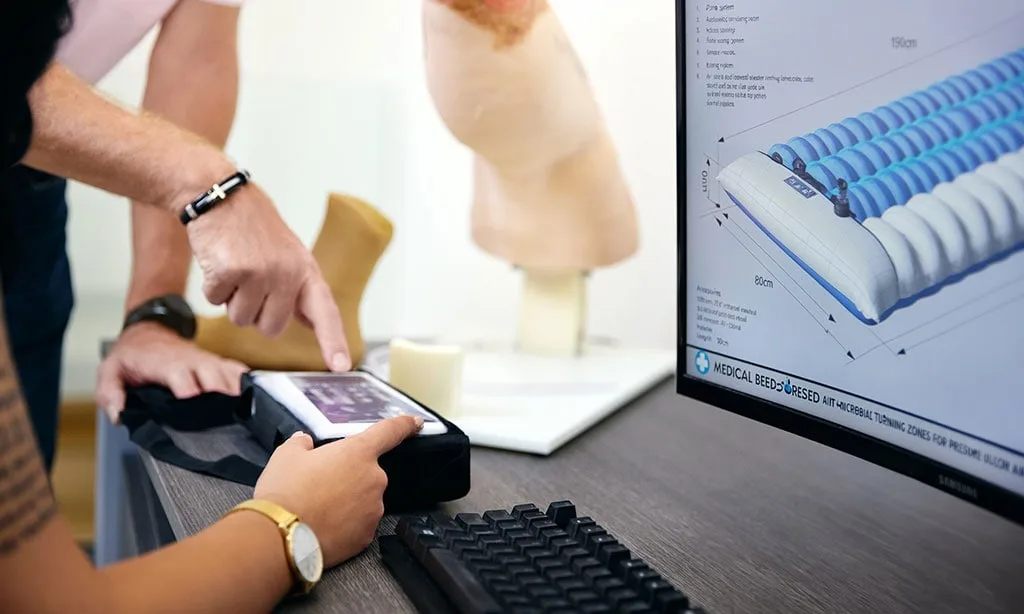
A rotating mattress for a hospital bed uses air-filled cells arranged in zones. They inflate and deflate in sequence, gently tilting the patient to one side, returning flat, then tilting to the other. Rotation angle is usually adjustable up to 30 degrees, and cycle intervals can be set based on the patient’s risk level.
Here’s the real difference from a standard air mattress for patient use: alternating pressure only changes the inflation beneath the body. A lateral turning mattress physically moves the patient. That distinction matters because the 2025 International Guideline identifies shear and friction as independent contributors to pressure injury, separate from pressure itself. You can’t address shear by inflating and deflating air cells alone.
The Staffing Case
The nursing workforce crisis isn’t going away. Ageing populations across Europe, North America, and parts of Asia are increasing the number of patients who need pressure injury prevention, while healthcare systems struggle to recruit and hold onto qualified staff. Something has to give.
Automated patient turning systems don’t replace nurses. They take one of the most physically punishing tasks off an already overstretched team. Manually repositioning a heavy, immobile patient takes two people and several minutes per turn. Across a twelve-hour shift on a full ward, that time stacks up fast.
Freeing up that time means nurses can focus on what actually requires clinical judgment: assessing the patient, managing medications, and being present. Those are the tasks no mattress can automate.
What to Look for in a System
Not every turning system is the same. Clinical teams should check whether the system provides alternating pressure alongside lateral turning, since each targets different risk factors. Noise matters more than most spec sheets suggest; a system that gets switched off at night because it’s too loud defeats its own purpose. Weight capacity, mattress dimensions, and whether it fits existing bed frames are all practical hurdles that affect real-world adoption.

Some manufacturers now offer multifunction systems that go well beyond turning. ABeWER, for instance, has developed a rotating mattress for hospital bed use that combines lateral turning with alternating pressure, continuous low pressure, microclimate control, and head and leg elevation in a single CE-certified device. That reflects what the clinical evidence keeps pointing to: pressure injury prevention needs to tackle multiple risk factors at once, not one at a time.
Prevention as Infrastructure
Switching to automated repositioning isn’t about swapping nurses for machines. It’s about building prevention into the physical infrastructure of care so it happens reliably, regardless of who’s on shift or how short-staffed the ward is that night.
Pressure injuries are among the most expensive and most preventable complications in healthcare. The technology to address them more reliably now exists. The hospitals moving in this direction won’t just see fewer injuries. They’ll also have wards where the nursing team isn’t buried in a task a mattress could handle.